Following on from my post about the decline of commercial fish species, here is Sylvia Earle's excellent TED Prize wish speech, sharing valuable information about the state of our oceans.
From TED.com:
Earle's work has been at the frontier of deep ocean exploration for four decades. Earle has led more than 50 expeditions worldwide involving more than 6,000 hours underwater. As captain of the first all-female team to live underwater, she and her fellow scientists received a ticker-tape parade and White House reception upon their return to the surface. In 1979, Sylvia Earle walked untethered on the sea floor at a lower depth than any other woman before or since. In the 1980s she started the companies Deep Ocean Engineering and Deep Ocean Technologies with engineer Graham Hawkes to design and build undersea vehicles that allow scientists to work at previously inaccessible depths. In the early 1990s, Dr. Earle served as Chief Scientist of the National Oceanographic and Atmospheric Administration. At present she is explorer-in-residence at the National Geographic Society.
"We've got to somehow stabilize our connection to nature so that in 50 years from now, 500 years, 5,000 years from now there will still be a wild system and respect for what it takes to sustain us."
- Sylvia Earle
Showing posts with label overfishing. Show all posts
Showing posts with label overfishing. Show all posts
Monday, March 29, 2010

Saturday, March 27, 2010
Overfishing and the problems it will cause

The global fishing industry is massively unsustainable. Some estimates put the global decline in fish stock at 90%. The best counter arguments that other scientists can come up with is that a) they didn't reflect local figures (which also show a decline) and b) it's actually only 70% or whatever massively too high but still lower than 90% number they've come up with today. The point is that fish numbers are declining. Fast. When we say 90%, we're talking about 90% in the last 50 years. The way things are going, every commercially harvested marine species will have crashed by about 2050.
And that's just fish in general.
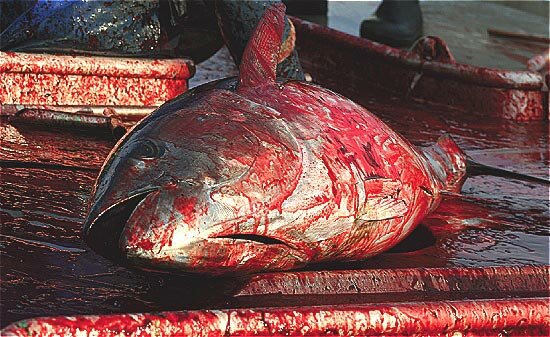
Bluefin tuna is as endangered as the white rhino, but it is still being hunted to extinction. If it was gorillas that were being eaten then thousands of people would be up in arms about it. But it's not. Fish are not cute, they're not seen as intelligent and they don't look like us. We can't see them, so we don't notice them declining. Out of sight, out of mind. And so it continues. Of course, the big companies aren't helping. Japan is alleged to have traded donor aid promises for votes to stop CITES from protecting tuna, and Mitsubishi is stockpiling frozen fish so that they can make money when the extinction of the species pushes prices up. All in all, things are not looking good.
Fish farming is not the answer people like to pretend it is. Farmed fish are fed on wild fish. It takes more fish to feed the farmed fish than what you get at the end of it.
What you can do:
- Find out more - knowledge is power
- Stop eating tuna
- boycott Mitsubishi
- Look for the Marine Stewardship Council (MSC) label on all fish products.
Find out more:
- The End of the Line: an excellent documentary about the current state of the fishing industry
- CITES failure to act (also here and here)
- WWF pages on threatened marine species
- Greenpeace and wikipedia articles on overfishing
Subscribe to:
Posts (Atom)